
Coaching
Coaching Games: How to Start a Session and Go Deeper
Coaching games can help clients get comfortable, show more of who they are, and discover something new about themselves. But with so many games and activities to choose from, how do you know which one to play? More importantly, how do you turn a few minutes of play into something useful for your coaching session?
By Danielle Lloyd · October 29, 2026

Coaching games can help clients get comfortable, show more of who they are, and discover something new about themselves.
But with so many games and activities to choose from, how do you know which one to play? More importantly, how do you turn a few minutes of play into something useful for your coaching session?
The good news? You don't need a complicated game or an elaborate lesson plan.
You need a little curiosity, a willingness to play, and your own coaching expertise.
Why use games in coaching sessions?
Picture this.
You're sitting across from a new client. Maybe they're ten years old and would rather be anywhere else. Maybe they're seventeen and tired of answering questions about school. Maybe they're twenty-two and perfectly happy to talk, but you've both fallen into the same familiar check-in routine.
You want to connect with them. You want to understand how they think, what motivates them, and where they might need support.
But you don't necessarily want to begin with another interview.
That's where coaching games come in.
1. Help clients feel comfortable
There's something nice about having an activity to focus on together.
Instead of sitting across from someone waiting for the next question, you're both looking at the same game. There's something to do, something to laugh about, and perhaps a little friendly competition.
The conversation doesn't have to carry the entire session.
2. See more of who they are
Games give people opportunities to make choices, try strategies, respond to surprises, and show their personalities.
You might notice someone taking their time before every decision. Someone else might jump right in. Another person might invent an entirely new way to play.
None of those observations tells you everything about a client. But they can give you something interesting to explore together.
3. Create opportunities to go deeper
Sometimes a game leads naturally into a conversation.
Maybe someone surprises themselves by taking a risk. Maybe they discover they enjoy something they expected to dislike. Maybe a small frustration gives you both an opportunity to talk about what happened.
Other times, you simply have a great time playing.
Not every game needs to become a lesson.
The relationship you're building matters, too.
What makes a good coaching game?
Here's my short answer:
The best coaching game is one your client is willing to engage with.
That's it.
It doesn't have to be labeled educational. It doesn't need a list of executive functioning skills printed on the box. It certainly doesn't need to feel like homework.
What matters is what happens when you put it in front of someone.
Here are three things I consider when choosing coaching games.
Tip 1: Pay attention to what happens, not just what the game is supposed to teach
Let's say you pull out a game of checkers.
You might be thinking about planning ahead, considering options, or adjusting strategies.
But perhaps your client spends the entire game trying to make you laugh. Or maybe they become fascinated with inventing new rules.
That wasn't necessarily what you expected.
It might still be the most interesting part of the experience.
The same thing can happen with word games, trivia, matching games, or activities that involve a little risk.
Imagine playing trivia with someone who strongly prefers knowing the correct answer before speaking. You might notice that they're comfortable answering familiar questions but hesitant to guess.
That doesn't automatically mean anything about how they approach challenges outside the game.
But it gives you a chance to ask:
“I noticed you were pretty sure about that answer before you said it. What made you decide to go for it?”
Now you have a conversation.
The game provides the opportunity. Your curiosity and coaching expertise help you decide what to explore.
Tip 2: Offer choices, but not too many
Choice can make a big difference in how someone approaches a session.
But putting fifteen games in front of a client and asking them to choose can turn something fun into another decision they have to make.
I usually prefer offering two or three options.
You might say:
“We can do something competitive, something creative, or something that makes us think a little. What sounds good today?”
You can even offer two very specific games.
As you get to know someone, you'll start recognizing what they enjoy, what they're curious about, and when they might appreciate something different.
Sometimes they'll surprise you.
That's part of the fun.
Tip 3: Know when to keep playing and when to explore
One of the most useful things you can bring to a coaching game is flexibility.
You might begin with a five-minute activity and discover something worth discussing.
Or you might have a client who's had a difficult week and really needs ten minutes of familiar, enjoyable play before they're ready for anything else.
You don't have to force a transition just because you've planned one.
When something interesting does come up, you can keep it simple:
“What made you choose that?”
“Would you do anything differently next time?”
“Was that what you expected?”
“Does that remind you of anything outside this game?”
Sometimes one question is enough.
Other times, it's better to let the moment pass and keep playing.
You're still the coach. The game is simply another tool you can use.
Three coaching games you can try right now
You don't need special software or an expensive collection of games to get started.
Here are three approaches I enjoy using, both in person and virtually.
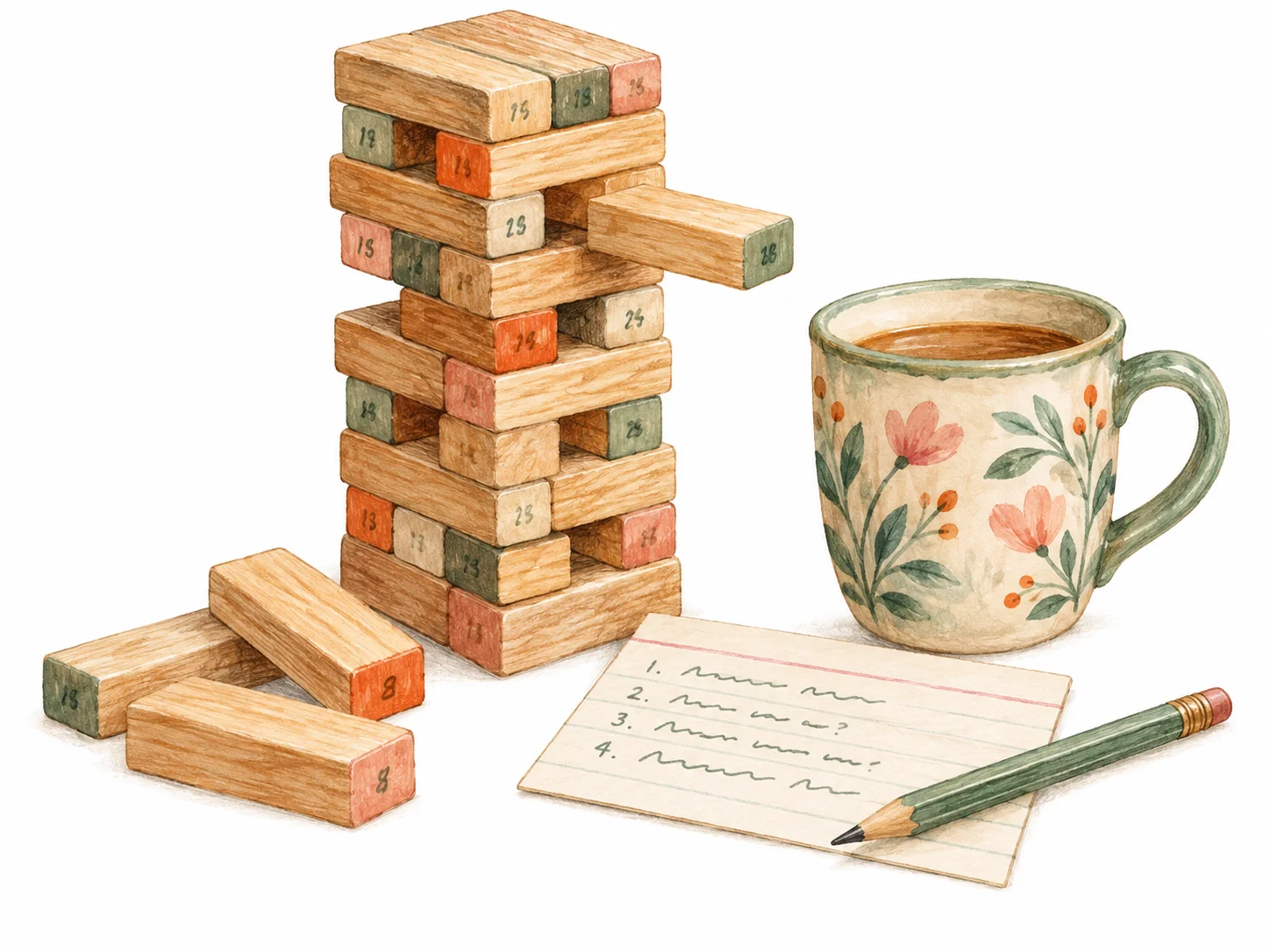
1. Numbered tower blocks with surprise questions
Best for: In-person coaching, rapport building, and getting to know someone.
This is one of my favorite ways to turn a familiar game into something a little different.
Start with a wooden stacking tower, like Jenga, and number the blocks. Create a matching list of questions, one for each number.
When someone pulls a block, they answer the corresponding question.
You can keep the questions completely lighthearted:
What's a food you'll defend no matter what anyone says?
If you could instantly become good at something, what would it be?
What's something people are surprised to learn about you?
Would you rather have a pet dragon or a personal robot?
What's something you wish adults understood better?
You can also mix in questions about goals, habits, decisions, or everyday challenges.
The beauty of this activity is how easily you can adapt it.
You can use it with younger kids, teenagers, college students, and adults. Change the questions to fit the person and the purpose of the session.
Coach's note: You don't have to turn every block into a serious conversation. Sometimes the ridiculous answers are the ones that help someone relax.
2. Balancing and stacking games
Best for: In-person coaching, quick session openers, and shared challenges.
I love a good balancing game.
There's something about carefully placing a piece, watching everything wobble, and hoping the whole thing doesn't come crashing down.
These games are easy to introduce, don't require a lot of explanation, and can appeal to a surprisingly wide range of ages.
You can play competitively or work together toward a shared goal.
While you're playing, you might notice how someone approaches the challenge. Do they experiment? Ask for suggestions? Laugh when the tower falls? Want to try again?
You don't need to analyze every move.
Sometimes you can simply ask:
“Okay, what's our strategy this time?”
Or:
“Do you want to try something different?”
A familiar game can give you a new way to interact without making the session feel like an assignment.
3. A quick online risk-and-reward game
Best for: Virtual coaching, decision-making conversations, and clients who enjoy a little competition.
Online coaching games don't have to be elaborate.
One simple option is a risk-and-reward challenge.
Give your client a choice between keeping a small number of points they've already earned or taking another turn for a chance to earn more.
You can create a basic version using a shared screen, a virtual die, or a few numbered choices.
The interesting part isn't necessarily who wins.
It's the decisions people make along the way.
Some clients love taking chances. Others prefer to protect what they've earned. Some change their strategies after a few rounds.
That gives you opportunities to explore how they approached the game, if it feels relevant.
You might ask:
“What made that risk worth taking?”
Or:
“When did you decide you'd earned enough?”
You can also simply enjoy the competition and save the reflection for another time.

Online coaching games vs. in-person coaching games
I use both, and I don't think one is automatically better than the other.
In-person coaching games can involve physical pieces, movement, drawing, building, or working together on a shared challenge.
Online coaching games make it possible to create many of those same moments through a shared screen, even when you're miles apart.
The important part isn't whether you're sitting at the same table.
It's whether the activity gives you and your client something meaningful or enjoyable to experience together.
Some clients love having a physical game in their hands. Others are completely at home interacting with something on a screen.
The format can change. Your role as the coach doesn't.
Want coaching games ready for your next session?
I created Opening Play because I wanted more ways to bring play, curiosity, and meaningful conversations into the sessions I was already leading.
Sometimes I need a quick game to help someone settle in. Sometimes I want a fresh check-in question. Sometimes we're having a great conversation, and I want a visual activity that helps us explore it further.
Opening Play brings those options together.
With 50+ interactive games, ready-to-use check-ins, 15 Session Enhancements, and a Playbook for every game, you can choose what fits the moment.
You don't need to build a separate activity for every client or turn every game into a lesson.
You bring the coaching expertise. Opening Play gives you more ways to use it.
Try Opening Play free for 14 days. No credit card required.